Startup Project
Product / UX Strategy · 2025
Pivoting an award search tool into a between-trips points platform — a pivot that carried our team through four elimination rounds to a VC-judged finalist pitch.
View case study
Trip Watchlist
Flights
Stays
Active Watch
updated 2 minutes ago
Lisbon, PT
BOS
1
Economy
≤ 40,000 pts
5 Programs
United Airlines
BOS - EWR - LIS
8h 35m
Mar 19
32,000 Miles
Air Canada
BOS - YYZ - LIS
9h 30m
Mar 19
33,250 Points
10+ Options
P

01
Overview
GetAway is a rewards-travel planning concept developed inside Boston University's startup competition.
Role
Product / UX Lead
Team
Cross-functional team of 6
Product, GTM, and Finance
Timeline
9 weeks · 2025
Tools
Figma
Miro
ChatGPT / Claude
02
Executive Summary
Challenge
My Role
Evidence
Decision
Reframe the concept from search-first trip planning to a between-trips points platform.
Status
03
Context
Points feel valuable.
Acting on them feels risky.
The business idea started as an award-search and trip planner. Feedback from mentors revealed the real challenge, and the subscription risk, lives in the decisions users make between trips.
Why rewards points feel risky to use
01
Value isn't stable — availability and pricing change
02
Rules are complex — transfer partners, ratio, constraints
03
Some actions are irreversible — points transfers
04
Opportunities expire — bonuses, deadlines
Job to be done
"Help me decide where I can go and what to do next with my points."
Round-one concept: an award-search engine that helps users search destinations and routes by award availability, and compare redemption options across programs. But search alone is most useful when booking intent is already high — which makes usage naturally episodic, and episodic usage is weak ground for a subscription.
04
Research
My Focus
Is trip planning episodic enough to break retention?
The concept was stuck at the "calculator/search" stage. I shaped the research to answer two decisions: whether episodic usage was really a retention risk, and what would create value between trips.
How I gathered input, with my team
Co-led interviews with peers across varied travel frequency and rewards sophistication
Co-led interviews with faculty with extensive business-travel experience
Synthesized mentor and VC feedback from elimination rounds into themes and pivots
Secondary research on typical rewards behaviors and opportunity patterns
Our sample size skewed toward our program's network. To offset that, I triangulated interview themes against secondary research on rewards behavior and against mentor/VC feedback across elimination rounds.
Research snapshot
Structured interviews
Low-fi prototype walkthroughs
Described trip planning as a short burst and expected to stop using a search tool after booking.
"How often do you check your points balance?"
Never — 50%
Occasionally — 36%
Weekly — 14%
Top triggers for points activity
9 of 14
Transfer bonuses, "sweet-spot discoveries," etc.
7 of 14
Sign-up bonuses, category spending — e.g. using a specific card to earn 4x on dining
6 of 14
Points optimization, gamification, and status chasing
What faculty and peers told us
— Faculty
— Peer
— Faculty
Insights
Trip planning is episodic, so a search-only product won't justify a paid subscription.
The between-trip experience has to be fast and low-effort, or it won't get used at all.
People only pay attention when there's a specific reason to act: a transfer bonus, an expiration deadline, or being close to a goal.
05
Ideation
Changing the center of the product.
If GetAway only helped when a user was actively planning a trip, it would struggle to create repeat value. Guided by the research, we generated and compared concept directions to find what would make users return — a shift from a search-first calculator to a service that helps between trips.
My Contribution
Featured Concept
Value Frequency
User Effort
Feasibility
Decision
Points dashboard
High
Low
High
Prioritize
Personalized promotions
High
Low
Medium-high
Prioritize
Award watchlist
Medium
Low
Medium
Explore
Automated balance syncing
High
Low
Low-medium
Later
Automated booking
Low
Low for user
Very low
Deprioritize
Prioritization Outcomes
We've moved forward with features that could create recurring value, require little ongoing effort from users, and remain feasible for an initial product experience:
Points net worth + value range and multi-program breakdown, to remove pre-search setup
Active promotions personalized to the user's ecosystem
A trip goal that keeps travel aspirations visible between trips
Product Thesis
"GetAway helps users turn points into trips: search what you can book, then stay ready between trips with time-sensitive next steps."
06
Solution
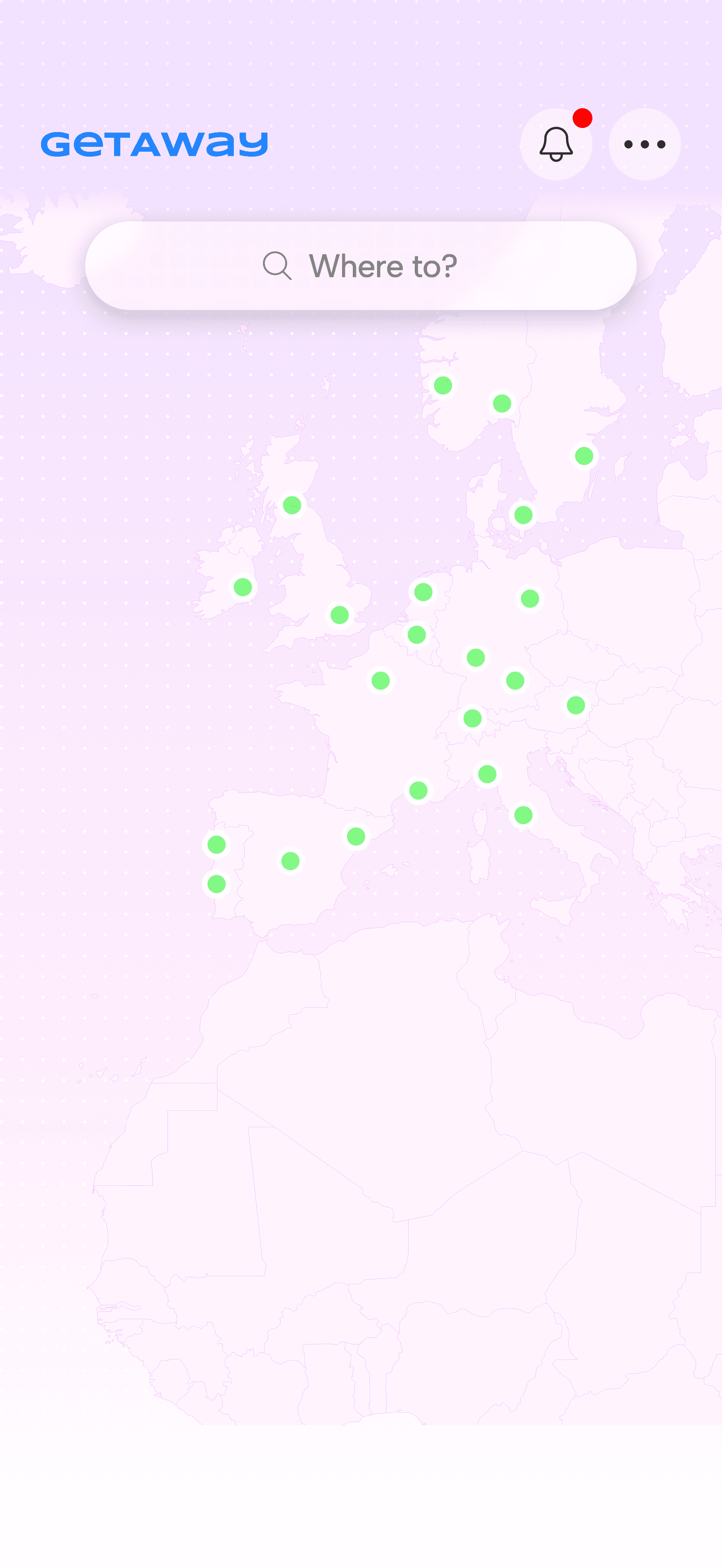
Interactive
Dashboard



Explore
Explore Map + List
Map
List
P
Explore
1 Month
2
London

+3
58K
+$5.60
1 Stop
Business

Madrid
+3
60.23K
+$12.80
Nonstop
Business
Amsterdam
+1
78K
+$12.80
1 Stop
Business
Map + List
01
02
03
04
Trip


07
Results
A presentation to VCs, after four elimination rounds.
The final pitch had three parts: Product, Go-To-Market, and Finance. I led the product portion with one teammate from GTM, presenting the screens and fielding product and technical-feasibility questions from the judges. The judges responded well to the clarity of the product story and the logic behind the pivot.
What I delivered
Impact
01
Competition outcome
02
Proposed user value
03
Strategic value
If I have more time
01
Usability-test the prototype with rewards users outside our program network, to validate clarity, ease of use, and flow.
02
Pressure-test the retention thesis itself: is between-trips utility frequent enough to sustain a subscription, or does the model need a transaction-based revenue layer?
08
AI Disclosure
How I Used AI
AI was a working tool on this project. I used it where it multiplied speed, and kept the judgment calls.
Research Synthesis
Stress-Testing the Pivot
09
Reflection
